
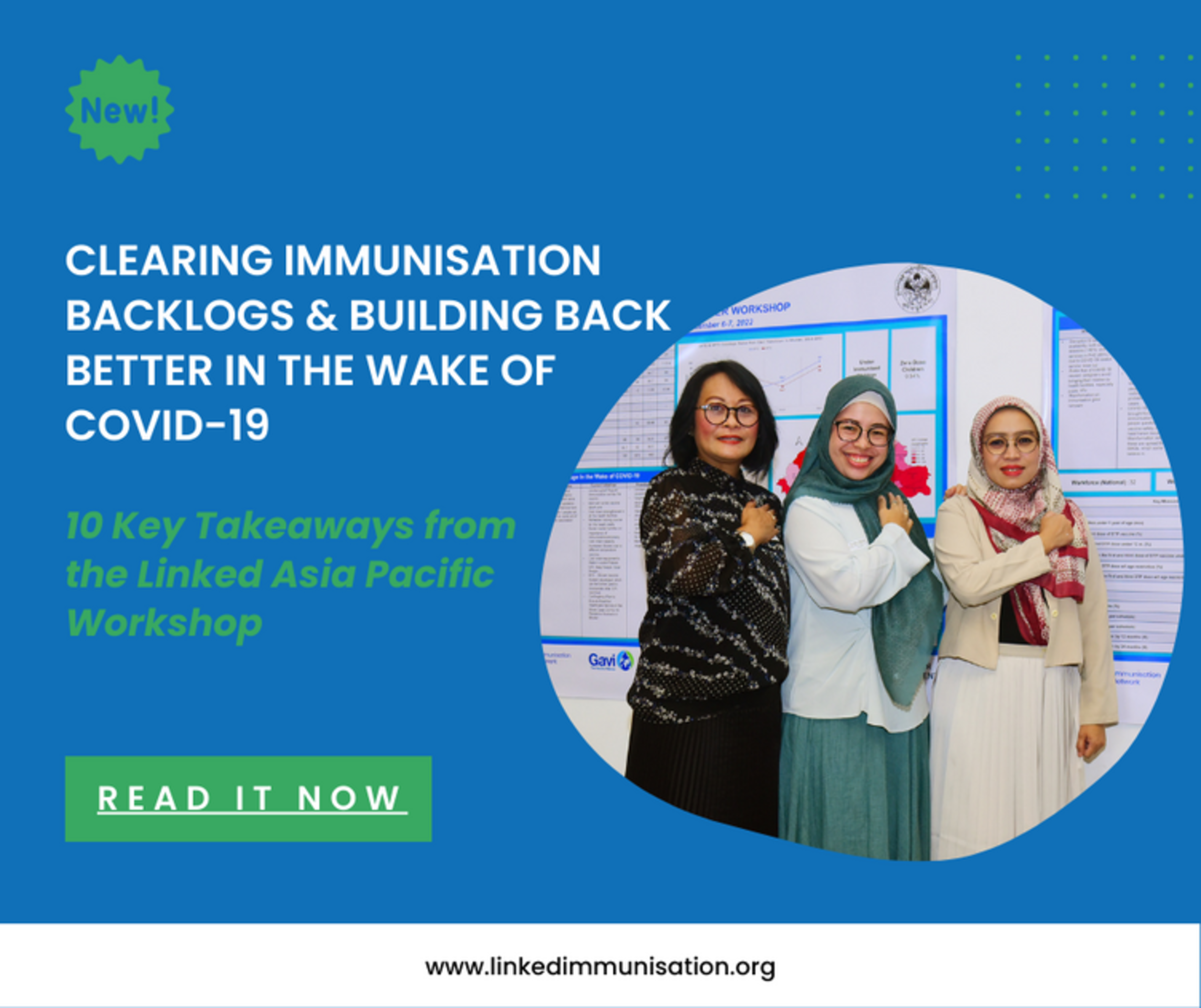
Clearing Immunisation Backlogs & Building Back Better in the Wake of COVID-19
The Linked Immunisation Action Network hosted an event in December 2022 entitled, "Clearing Immunisation Backlogs & Building Back Better in the Wake of COVID-19" with immunisation professionals from seven countries across the Asia Pacific Region. The workshop was led by the Institute for Health Policy (IHP) in Negombo, Sri Lanka, with the goals of better understanding country experiences during the COVID-19 pandemic, exploring strategies that worked well in maintaining and restoring immunisation coverage during and after pandemic peaks, and identifying best practices to strengthen immunisation programmes in the wake of the pandemic.
The Linked Immunisation Action Network published a brief highlighting ten key takeaways from this workshop, as well as common health system stressors and key mitigation strategies. This is useful for those who want to restore routine immunisation service, catch up missed children, and identify promising practices to clear immunisation backlogs and strengthen immunisation programmes to better withstand health system disruptions in the future.
Here is an overview of the 10 Key Takeaways:
1. Strategies to address service delivery disruptions included granting exceptional status to certain populations to allow access to services, extending vaccination clinic hours, modifying service delivery points to include curative care sites and other nontraditional vaccination sites, and integrating routine immunisation with COVID-19 vaccination sessions.
2. Strategies to address human resource challenges included providing surge capacity by engaging retired health workers and medical students, allied health professionals, first responders, and the military. Health worker shortages were also addressed by mapping and allocating health workers according to geographic need. To address burnout, countries offered financial and nonfinancial incentives to motivate and retain health workers.
3. Strategies to address data availability and quality included leveraging strong existing systems or building new systems (i.e., electronic immunisation registries) for COVID-19 vaccination, or relying on standard data monitoring and supervision approaches.
4. Strategies to address negative community perceptions of immunisation included conducting Information, Education, and Communication (IEC) campaigns, organizing advocacy meetings to address key drivers of vaccine hesitancy and refusal, and offering financial incentives to the community to seek vaccination services.
5. Countries likely need to employ a variety of methods to effectively restore routine immunisation services to catch up missed children. 6.Key service delivery approaches to clearing immunisation backlogs primarily include periodic intensification of routine immunisation (PIRI), supplementary immunization activities (SIAs), and catch-up immunisation campaigns.
7. In many countries, the magnitude of the backlog and approach to the catch up has been based on their strength in planning and maintenance and mitigation strategies.
8. The pandemic highlighted the importance of building trust in immunisation. Addressing vaccine hesitancy can take the form of continuous and persistent broadcasting of correct immunisation messages to increase community knowledge and health seeking behaviour. Involving respected stakeholders, such as religious and other key community leaders, can help to build trust, which can be crucial for vaccine acceptance.
9. The operational challenges many countries faced in rolling out COVID-19 vaccination could have been tackled more easily if they had an existing electronic immunisation registry in place, which many countries are now motivated to build.
10. As countries aim to build back better, they need to employ measures to strengthen routine immunisation (including by leveraging COVID-19 integration), address missed opportunities for vaccination, and reach zero-dose and under-immunised children.
What takeaway did you find most important based on your immunization experience? Can these takeaways from the Asia Pacific Region be applied to your region and context, and how so? Did the brief miss any takeaways you've learned in your work experience recovering from the COVID-19 pandemic? What has been the top challenges in your region to strengthening routine immunization & reaching zero-dose children in the wake of COVID-19?
Share your thoughts in the "Comment" section below!